The answer, up front: travelers, not treasure — mostly
Open any inherited jar and a few coins will not belong. They got there honestly — a grandfather’s war years, a honeymoon in Mexico, a father’s business trips — and almost all of them are worth exactly what they say on their face, in a currency you would have to fly somewhere to spend. A modern euro, a decimal British coin, a recent peso: face value abroad, souvenir value at home.
Almost all. Hidden among the travel change are a few families struck in real silver well into the twentieth century — British and Australian coins most often — plus one famous Austrian trade coin that turns up in jars on every continent. The sort takes minutes: read what you can, weigh what you cannot, and check the short list of silver windows below before anything goes back into the jar.
Foreign and worthless are not synonyms — the difference is a handful of dates.
The story: how the world got into the jar
American and Canadian jars are time capsules of ordinary travel. The big British pennies — a full inch and a quarter across, minted until 1967 — came home in the pockets of servicemen and immigrants. Mexican pesos crossed the border in fishing-trip change by the million. Euro coins are the modern layer: every returning traveler since 2002 has dropped a few into the jar rather than the exchange bureau, which refuses small coins anyway.
And then there is the deliberate kind: the world-coin bin at the coin shop, where dealers sell foreign coins by the pound. A handful bought for a grandchild in 1975 is a handful inherited in 2025, its origins quite forgotten. None of it is treasure, exactly. But somewhere in that handful, the dates below may be waiting.
What this means for your jar: the silver windows
Britain struck its everyday silver denominations — sixpences, shillings, florins and half crowns — in sterling silver, .925 fine, until 1919, then in .500 silver from 1920 through 1946, and only switched to cupronickel in 1947. A British shilling dated 1946 or earlier is a silver coin; the same coin dated 1947 is not. Australia ran the same pattern one step behind: its sixpences, shillings and florins were .925 silver to 1945 and .500 silver from 1946 to 1963. Canadian dimes and quarters have their own changeover years — that is Guide 10’s whole subject.
| British sixpence, shilling, florin, half crown | .925 silver to 1919; .500 silver 1920–1946; cupronickel from 1947. The 1946/1947 line is the whole game. |
|---|---|
| Australian sixpence, shilling, florin | .925 silver to 1945; .500 silver 1946–1963; no silver after 1963. The same game, one step behind Britain. |
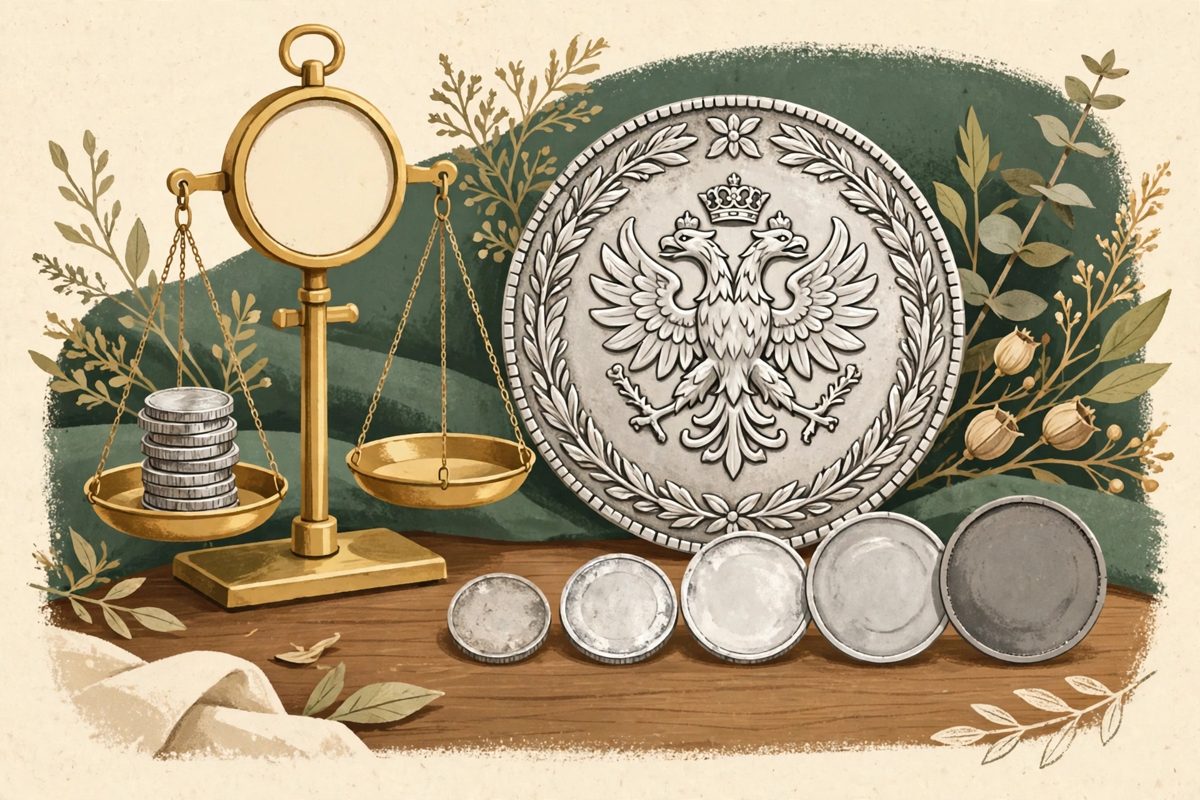
| Maria Theresa thaler | .833 silver, 28.07 g, dated 1780 — restruck for two centuries as trade money. The scale names it even when the lettering cannot be read. |
| Mexican coins before about 1950 | Often silver — pesos and many smaller denominations of the era. Date plus weight settles most of them; check before the spending pile. |
| Euros, decimal British coins, modern pesos | Face value abroad, souvenir value at home. No silver, no premium — the travel-money envelope. |
The jar’s most theatrical foreigner is the Maria Theresa thaler: a big, dollar-sized silver coin dated 1780, restruck for two centuries as trade money for Africa and Arabia. It is .833 fine silver and weighs 28.07 grams, so the scale identifies it even when the Latin lettering does not. Mexican coins from before about 1950 deserve the same treatment: many pesos and smaller denominations of that era are silver, and the date plus a weight check settles most of them.
The coins with holes deserve a sentence of their own, because they stop everyone. Most are Chinese cash coins — round, with a square hole, cast by the million for a thousand years — or their Japanese and Vietnamese cousins, carried home as curios. Age is not value here: common cash coins trade for very little, and a jar’s examples are almost always common. Keep one for the story it tells; do not build a retirement plan on the rest.
Everything else — the euros, the modern British decimal coins, the later pesos, the tokens and casino chips that sneak in — is face value or souvenir value. A euro coin spends in Europe and nowhere else; a handful of them is a reason to plan a trip, not a trip to the dealer.
Try it: the four-step world-coin sort
- Read the country, the denomination and the date. That trio, typed into any search engine, identifies ninety percent of jar foreigners in about a minute.
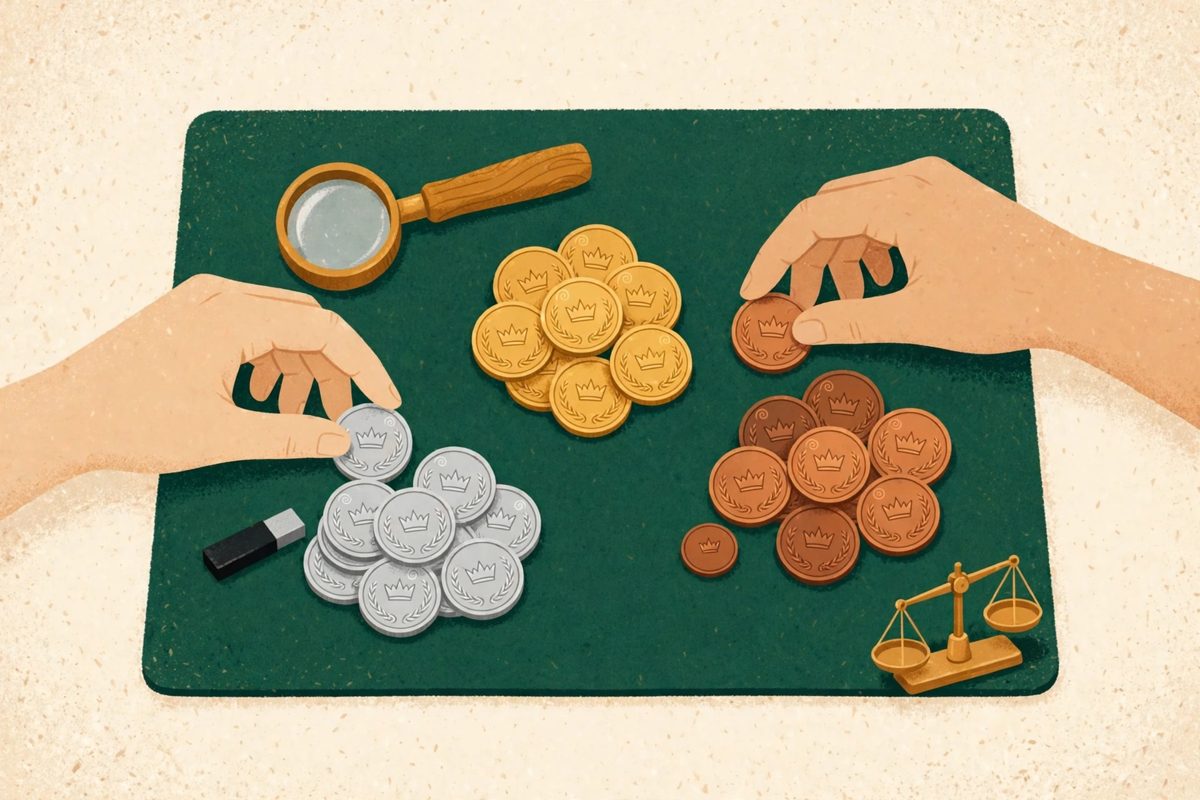
- Weigh and magnet-test the ones you cannot read. Anything European or Latin American dated before 1960 that resists identification goes on the 0.01 g scale and past the magnet — Guide 7’s kit does both. Silver is never magnetic, and its weight matches published figures.
- Run the silver windows. British to 1946, Australian to 1963, the 1780-dated thaler at 28.07 grams, Canadian dates per Guide 10. A coin inside a window goes in the keeper pile by weight, whatever language it speaks.
- Sort the rest without guilt. Modern base-metal coins are travel money. Keep the pretty ones as souvenirs; let the others go.
One caution, and it is the same one as everywhere in this hobby: do not clean any of them to read them better — Guide 4 explains why. A readable date is worth having; a scrubbed silver shilling is worth less than a dirty one.
The keepers deserve the same finish as any silver coin from the main catalogue: a Mylar flip, a label with the country and the date, and a line on the jar sheet. A dealer’s first questions about a foreign silver coin are the same as his first questions about any other — what is it, and what does it weigh — and a labeled keeper answers both before he asks.
The world coins in the jar are the family’s travel diary, written in small change — read the dates before you spend the story.