
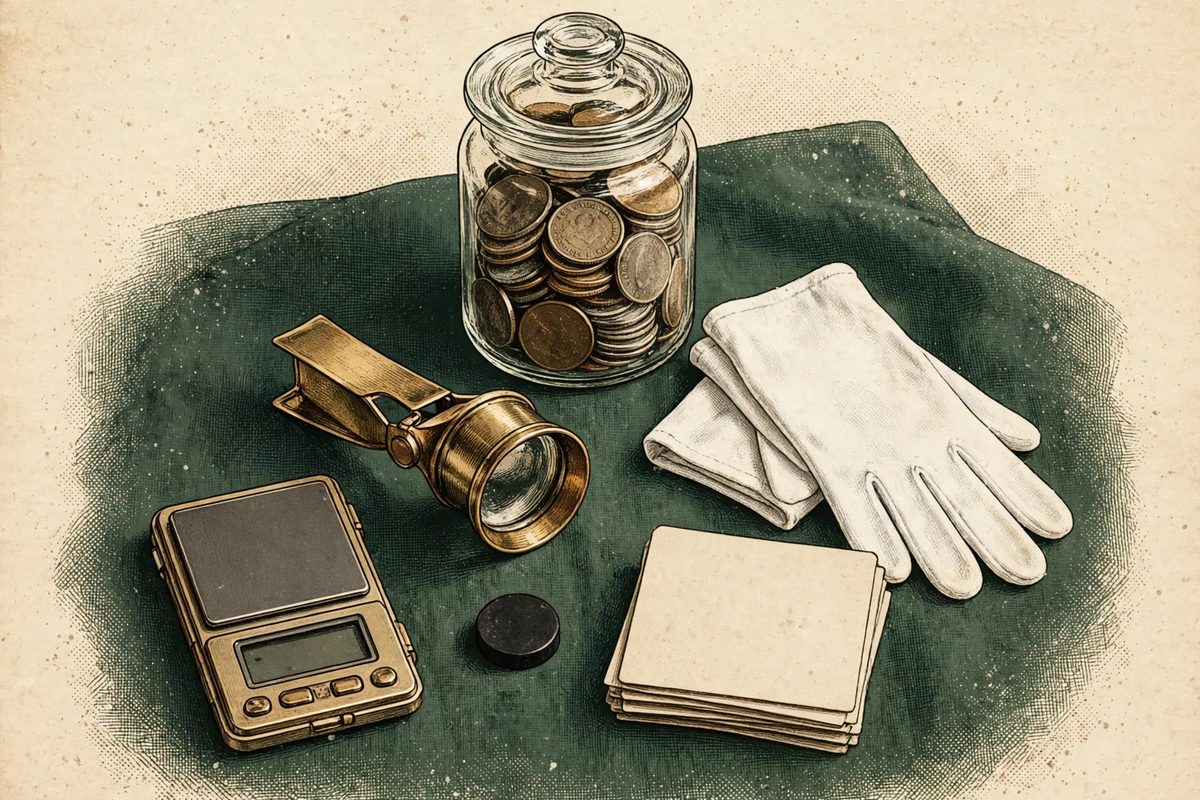
The answer, up front: five tools, five jobs
| Tool | The job it does | The test that proves it | Typical price |
|---|---|---|---|
| Pocket scale, 500 g × 0.01 g | Weighs every coin; weight is identity | A US nickel reads 5.00 g | $10–$25 |
| 10x triplet loupe | Reads dates and mint marks | A mint mark stays sharp at the edge of the lens | $12–$25 |
| Neodymium magnet | Settles the magnetic questions | A nickel 1968 dime snaps on; a silver one ignores it | $5–$10 |
| Cotton gloves + Mylar 2×2 flips | Handles and stores without harm | The flip bends stiff, never floppy | $12–$22 together |
| Daylight LED light | Lets you see, and photograph, worn detail | Raking side light makes a worn date readable | $15–$35 |
Bought together, the five typically add up to roughly $55–$105 — under $100 for most buyers. The prices are typical US retail prices checked in November 2026, a guide, not a quote, and JarSort does not sell any of it. The standing buying guide, with the full specifications, is the toolkit page — the same page Chapter 2 of The Coin Jar Handbook points to.
Five jobs — weigh it, read it, test it, hold it, photograph it. A tool that does none of the five is not kit; it is clutter.
The story: how the junk drawer happens
Nobody plans a junk drawer. It accumulates one hopeful purchase at a time, and the pattern is always the same: the gadget arrives before the job it was meant to do is understood. The first purchase is often the worst one — a cleaning kit, bought to make old coins look better, when Guide 4 exists precisely because cleaning is the one intervention that reliably destroys value. Then come the 30x and 60x novelty loupes, all magnification and no field, with plastic lenses that fringe every letter they enlarge. Then the kitchen scale that reads to a tenth of a gram and therefore cannot separate a single pair of coins that matters. Then the album, bought before one coin has been sorted, in the wrong size.
Each of those purchases answered an advertisement. The jar answers back with a workflow, and the workflow has exactly five jobs in it. The sorter weighs the coin, because weight is identity (Guide 2). It reads the edge and the tiny letters, because the edge splits silver from clad and the letter can change the price (Guide 3, Guide 5). It tests the metal with a magnet, because two of the commonest jar questions are magnetic ones. It handles and stores what survives, because fingerprints and plastic are forever. And it photographs, because a good photograph is what identification, records and honest selling all run on. Five jobs, five tools — and a test for each, so the kit can prove itself before a single valuable coin is at stake.
What this means for your jar: the five, one at a time
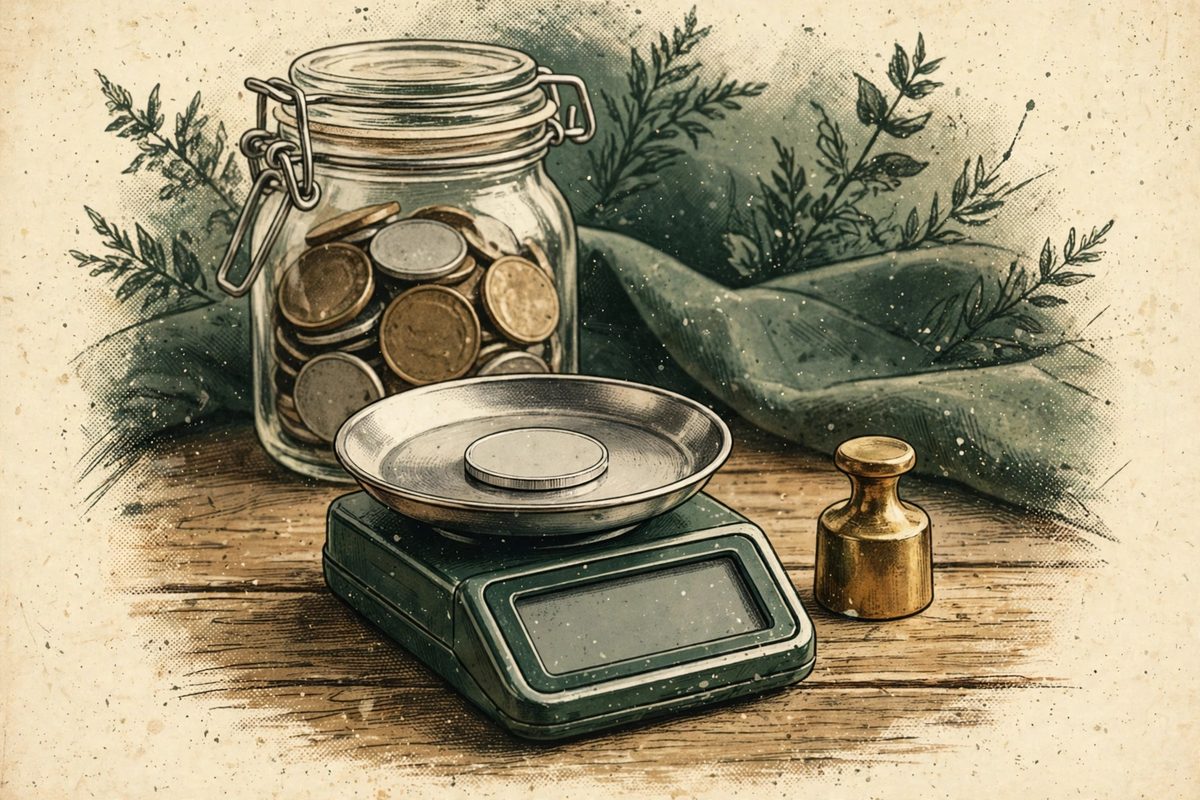
1. The scale — buy 0.01 g or do not buy. The specification is 500 g capacity, readings to a hundredth of a gram, and a calibration weight included or accepted. The test is Guide 2’s: every US nickel weighs 5.00 g, so a scale that finds 5.00 on a nickel can be trusted with the 6.25 g silver quarter and the 5.67 g clad one. The wrong tool is the 0.1 g kitchen scale — it rounds those two quarters to nearly the same number, and the whole silver sort collapses. Typical price $10–$25; full buying notes on the toolkit page.
2. The loupe — triplet, or walk away. The specification is a true 10x triplet — three lens elements correcting the image together — about 21 mm across, glass in a metal frame. The test: hold a coin so its mint mark sits at the edge of the lens, where Guide 5 says the money hides. Through a triplet the letter stays sharp and colour-true; through a cheap singlet it swims and fringes. The wrong tools are the chrome dollar-store loupe and the 30x/60x novelty pair — too much power, too little field. Typical price $12–$25; full buying notes on the toolkit page.
3. The magnet — strength is the whole point. The specification is neodymium, the rare-earth kind, a disc or bar about 10–20 mm. Its two party tricks settle real jar questions: the 1943 steel cent sticks to it (and the bronze 1943 error — the valuable one — does not), and among 1968 Canadian dimes the nickel issue snaps on while the silver issue ignores it, as Guide 3 shows. The wrong tool is a ceramic fridge magnet, too weak to settle either question. Typical price $5–$10; full buying notes on the toolkit page.
4. Gloves and flips — stiff is safe. The specification is plain soft cotton gloves, and flips made of Mylar — full stop. The test is a bend: Mylar is stiff and crackly, while soft, supple vinyl is PVC, the holder that sweats a green slime onto coins over the years (Guide 4). Handle everything by its edges, gloved or clean-handed, and let the keepers live in the flips. Typical price $12–$22 for gloves and a 100 pack of flips together; full buying notes on the toolkit page.
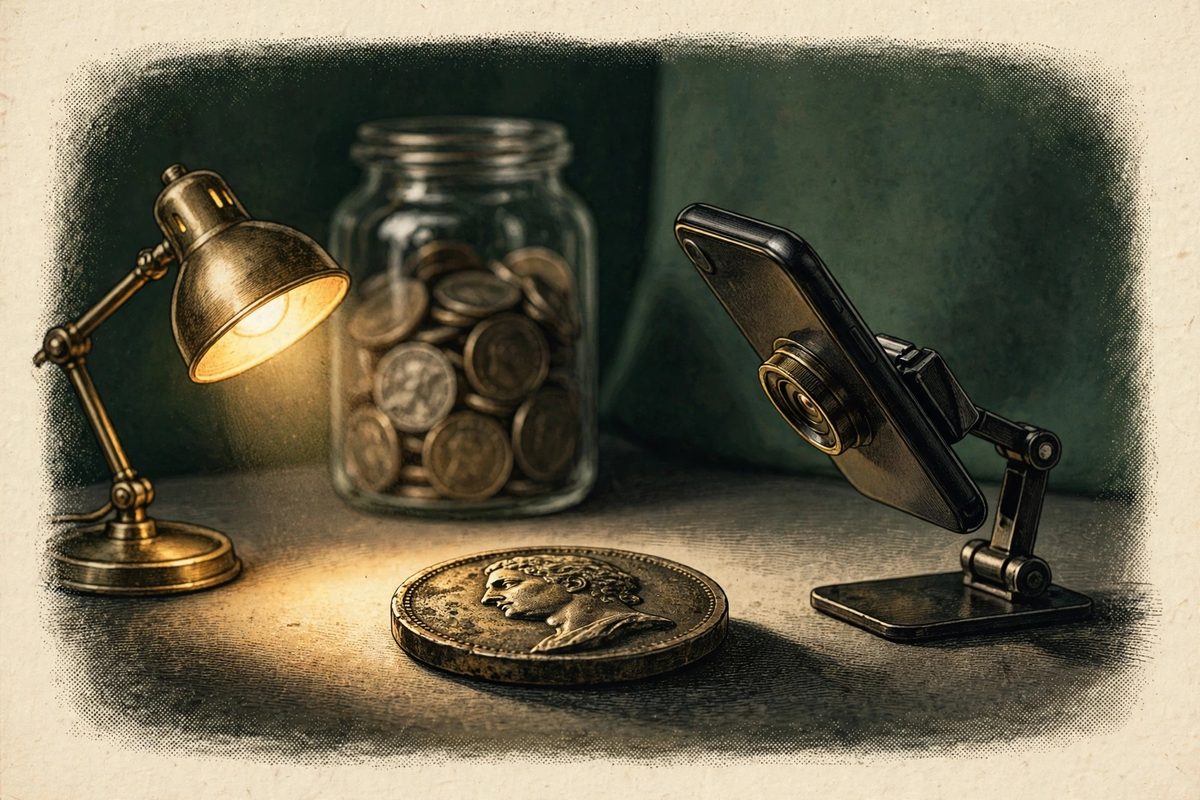
5. The light — daylight, from the side. The specification is a daylight LED, about 5000–6500K, on an arm you can angle — or a small folding light box, which does the same job tidily. The test: lay a worn coin under it and rake the light in from the side; a date that was invisible straight-on stands up in relief, on the coin and in the photograph. The wrong light is a warm household bulb, which flatters cleaned coins and lies about colour, and the straight-down phone flash, which blows out exactly the letters the photo exists to record. Typical price $15–$35; full buying notes on the toolkit page.
Try it: assemble the kit in one pass
Buy in the order the jar needs the tools: scale first, because it settles the most questions per dollar; loupe second; magnet third; gloves and flips when the first keeper appears; light when you start photographing for identification or for a dealer. Prove each tool with its test the day it arrives, while the receipt is still fresh — a tool that fails its test has told you something worth far more than its price. Then put the kit to work on the jar itself: run one coin through the sorter, weigh it, read its letter, and file it in a flip.
Buy the test, not the toy. A tool that can prove itself on a nickel, a mint mark and a magnet has earned its place in the kit.