The answer, up front: three coins, three tells
The 1964 rule is real — dimes, quarters and halves struck after 1964 lost their ninety percent silver. What the rule leaves out is that silver did not stop; it went quiet, in smaller doses, in coins whose dates look safely modern. These are the three that turn up in jars:
| Jefferson nickel, 1942–1945 | 35% silver. The tell is on the back: an oversized mint mark above the dome of Monticello. Catalogue sold range $3.20–$3.50. |
|---|---|
| Kennedy half dollar, 1965–1970 | 40% silver. The tell is the edge: a pale sandwich line instead of the bright copper stripe on modern clad. Catalogue sold range $10.40–$12.50. |
| Eisenhower dollar, S mint, 1971–1976 | 40% silver — San Francisco collector issues only. The tell is the S mint mark, confirmed by weight: 24.59 g against the clad coin’s 22.68 g. Catalogue sold range $23–$27. |
The ranges are the JarSort catalogue’s researched sold ranges as of October 24, 2026; melt values move with the spot price, which the homepage updates daily. Everything else in a post-1964 pile really is face value — these three are the exceptions.
1964 is when silver got quiet — not when it stopped.
The story: the pile that almost went to the bank
It is the most ordinary sorting session there is. A jar comes off a shelf, the coins pour out, and the sorter applies the rule everybody knows: 1964 and earlier to the left, everything later to the right, and the right-hand pile goes to the bank. In one such pile sat eleven Kennedy halves dated 1965 to 1970. Counted the bank’s way, they were five dollars and fifty cents. Counted as what they actually are — forty percent silver, at ten forty to twelve fifty each in the catalogue — they were worth well over a hundred dollars.
Nothing about those halves announced itself. Same size as a modern half, same portrait, nearly the same colour. The only witness was the edge, and nobody had looked at it. That is the pattern of this whole guide: silver in modern-looking coins is found by the three tells — a mint mark in an odd place, an edge the wrong colour, a coin two grams too heavy — never by the date alone.
Hider one: the wartime nickel, 1942–1945
In 1942 the United States needed nickel metal for the war, so from late that year the five-cent piece gave its nickel up and was struck instead in an alloy that was thirty-five percent silver. The change ran to the end of 1945. Hundreds of millions were made, and they circulated for decades — jars are full of them.
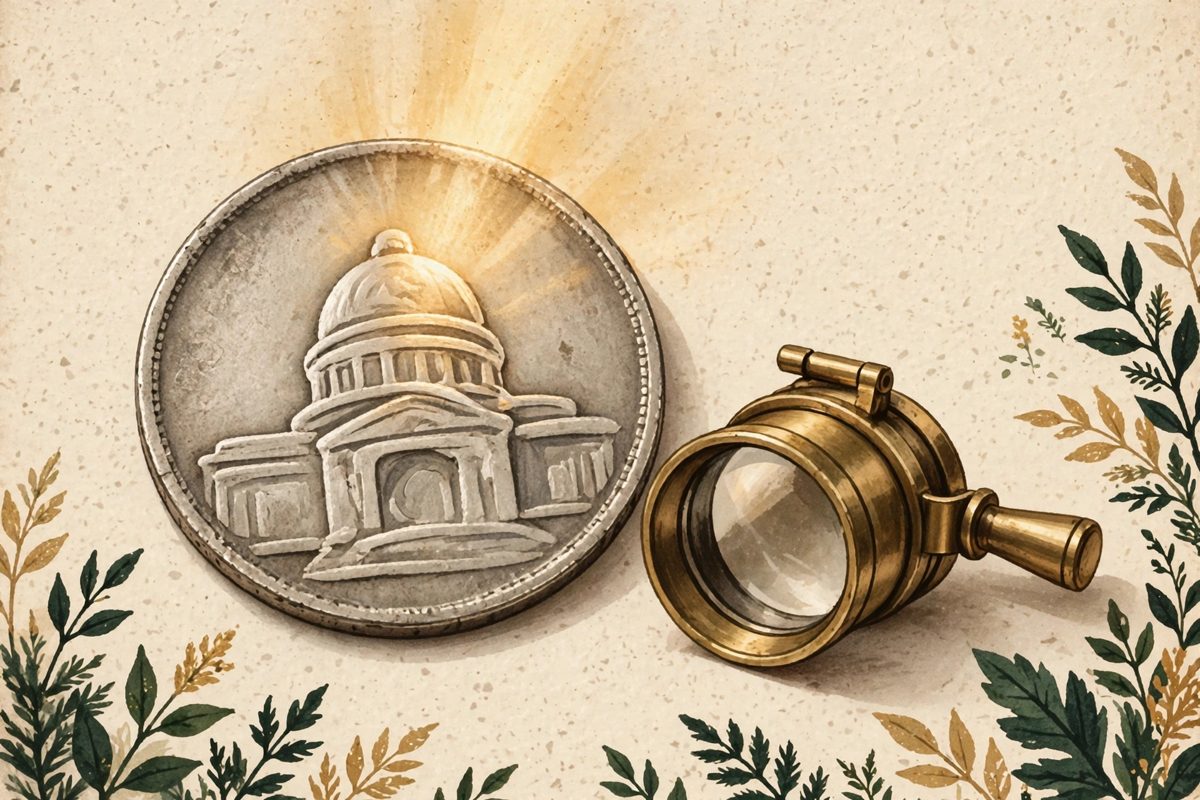
The tell is simple. Flip the nickel over. On ordinary Jefferson nickels the mint mark, if there is one, is small and sits beside Monticello. On the wartime coins it moved above the dome and grew oversized — a big P, D or S that is hard to miss (the P was Philadelphia’s first-ever mint mark). Big letter above the dome: silver. And the caution that comes with it: early 1942 nickels without the big mark are the regular alloy, struck before the change. The date gets your attention; the mark is the proof. In the catalogue the wartime nickel carries 0.0563 troy ounces of pure silver and sorts at $3.20–$3.50, with a dealer’s likely offer lower, around $2.10–$2.60 — thin silver trades at a wider discount than the ninety percent coins.
Hider two: the forty-percent halves, 1965–1970
When the silver era ended, the half dollar did not go straight to base metal. From 1965 to 1970 it was struck with a silver-clad sandwich — forty percent silver overall. Millions were spent by people who assumed the date made them ordinary, which is why they still surface in jars today.
That edge is the tell, and it takes one second: stand the coin on its side. A modern clad half shows a bright copper stripe. A forty-percent half shows a paler, greyer line — silver-rich outer layers over a lighter core. It is the same test as the silver edge test, just with the volume turned down. One more date to treat with respect: the 1970-D was issued only in mint sets and never released for circulation, so any 1970 half is worth pulling out on sight. The catalogue puts the 1965–1970 halves at 0.1479 troy ounces of pure silver, sold range $10.40–$12.50 — twenty times face value, hiding behind a date most sorters wave through.
Hider three: the S-mint Eisenhower dollars, 1971–1976
The big Eisenhower dollars of the 1970s exist in two metals that look identical. The ones made for circulation — Philadelphia and Denver — are copper-nickel clad and worth a dollar. But San Francisco also sold a forty percent silver version to collectors, in 1971 to 1974 and again for the 1976 Bicentennial issue: the “blue Ikes” (uncirculated) and “brown Ikes” (proofs). Decades on, those collector coins get spent, inherited and jarred like any other dollar.
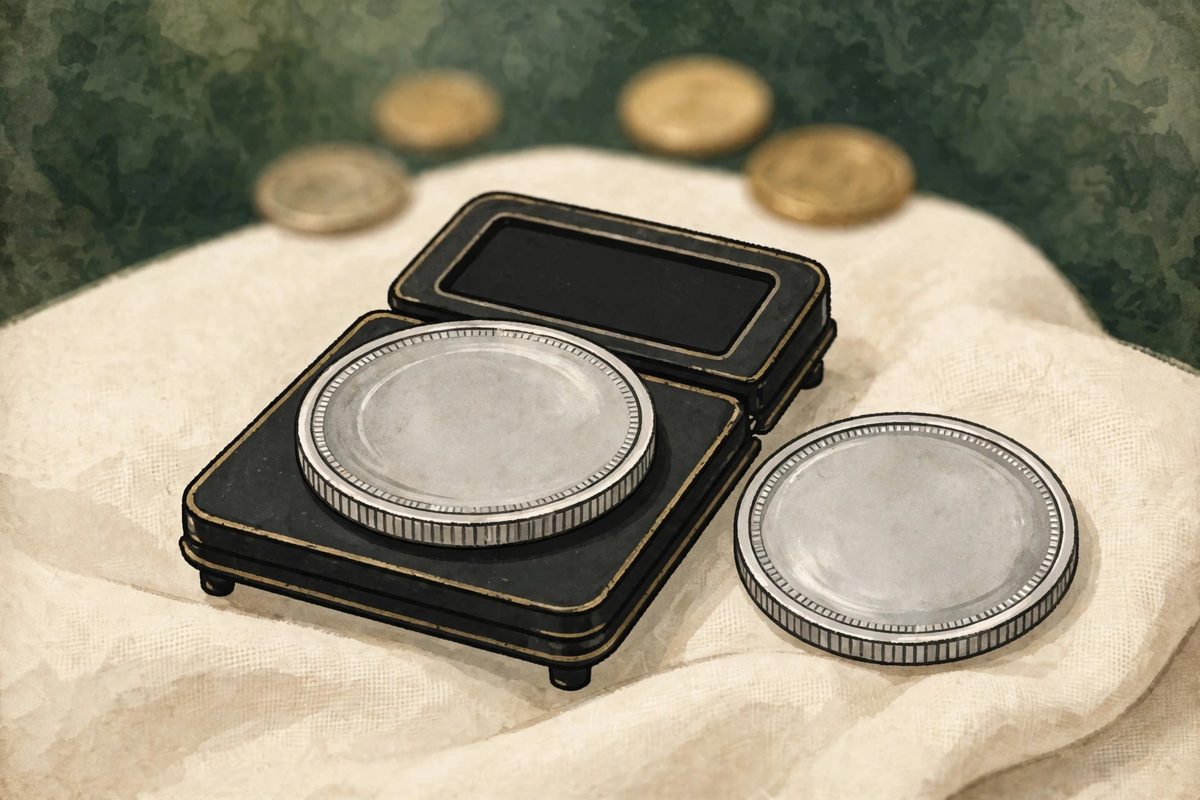
Two tells, either one enough. First, the mint mark — only an S counts. Second, and decisive, the scale: the silver coin weighs 24.59 grams against the clad coin’s 22.68, a gap any pocket scale reads instantly (the method is in reading a scale for coins). The catalogue gives the S-mint silver Ike 0.3162 troy ounces of pure silver and a sold range of $23–$27 — the single most valuable coin most jars are hiding.
The near-misses that are not silver
Three lookalikes to leave in the spend pile. Kennedy halves from 1971 on are clad, however silvery they look. Eisenhower dollars with a P or D mint mark are clad in every year, 1976 included. And silver-coloured is not silver: plenty of modern coins are simply pale. Canada ran its own version of the trap in 1968, when dimes and quarters were struck in both half silver and pure nickel — that split is covered in the 1967 and 1968 Canadian guide. The discipline is the same everywhere: a date earns a coin a second look; only the mark, the edge or the scale earns it a place in the silver pile.
Try it: ten minutes over the spend pile
- Take the pile you were about to bank and spread it on the table. Pull every half dollar dated 1965 to 1970 and stand each one on its edge — pale line, silver; copper stripe, back it goes.
- Pull every nickel dated 1942 to 1945 and flip it over. Big mint mark above the dome means silver; no big mark, back it goes.
- Pull every Eisenhower dollar and read the mint mark under the portrait. S goes on the scale — 24.59 g confirms it.
- Run what survives through JarSort for its three numbers — the first three verdicts are free — and start a silver pile with labels, the way the executor’s checklist keeps them.
That is the whole second pass — ten minutes, no tools beyond a scale, and the pile that was priced at face value gets counted honestly. 1964 is when silver got quiet. The jars are still full of the quiet years — now you know where they hide.