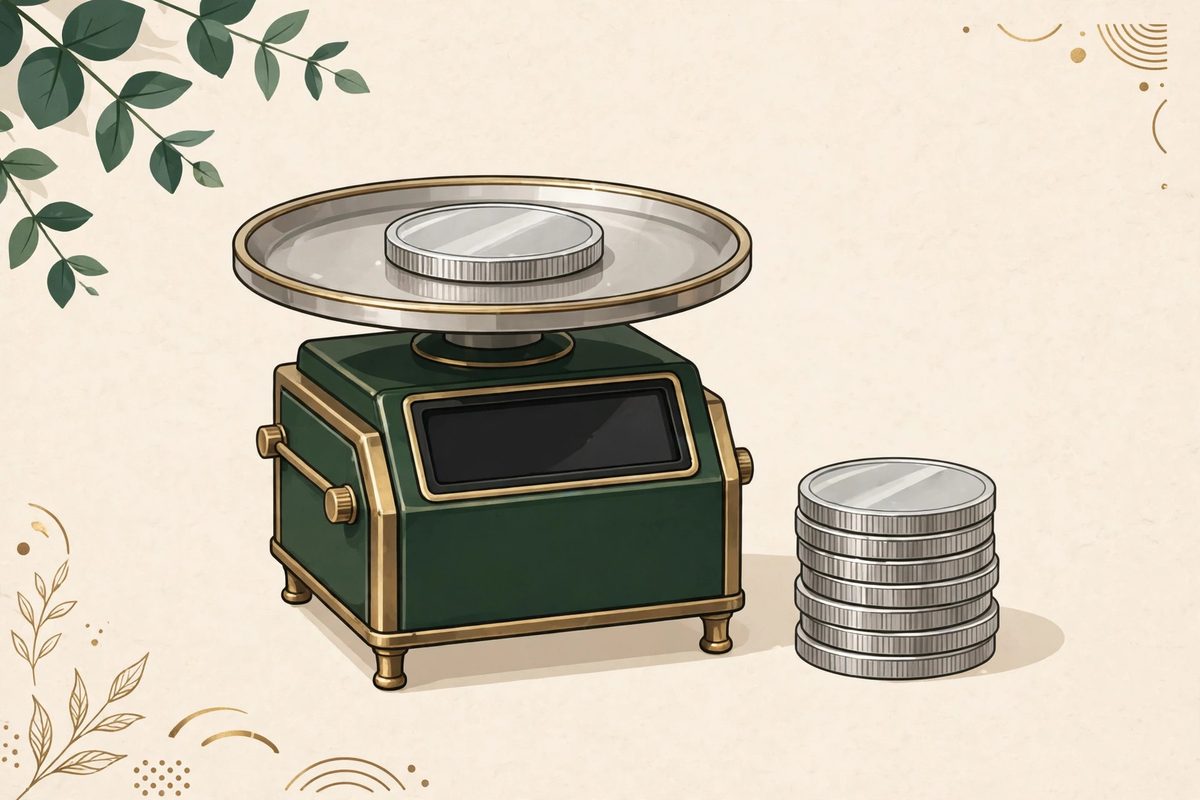
The answer, up front: what coins should weigh
| Coin | Weight | Why it matters |
|---|---|---|
| US nickel (any year since 1866) | 5.00 g | Your free calibration weight: 1 nickel = 5 g, 20 nickels = 100 g |
| US cent, modern (1983–today) | 2.50 g | Zinc core; the light penny |
| US cent, copper (before 1982) | 3.11 g | The scale tells copper from zinc without a date check |
| US cent, steel (1943 only) | 2.70 g | Plus it sticks to a magnet — two tests, one answer |
| Quarter, silver (before 1965) | 6.25 g | vs. clad below: the scale settles the 1964/1965 argument |
| Quarter, clad (1965–today) | 5.67 g | Modern sandwich coin |
| Dime, clad | 2.268 g | Silver dimes (before 1965) weigh 2.50 g instead |
| Morgan / Peace dollar | 26.73 g | Near it = healthy; near 25 g = heavy wear or wrong coin |
| Silver Eagle / Maple Leaf, 1 oz | 31.103 g | One troy ounce exactly — see Guide 1 |
And what the scale’s modes mean
| Mode | Unit | In grams |
|---|---|---|
| g | Grams | — use this one |
| ozt | Troy ounces (bullion) | 1 ozt = 31.1035 g |
| dwt | Pennyweights (jewellers, pawn shops) | 1 dwt = 1.555 g · 20 dwt = 1 ozt |
| oz | Regular ounces (kitchen) | 1 oz = 28.3495 g — the trap from Guide 1 |
Trust grams, check with nickels, and let the scale do the arguing.
The story: coins were born to be weighed
For most of history, a coin was not a promise of value — it was the value, a measured piece of metal with a government stamp guaranteeing the measurement. That is why mints struck to legal weight tolerances, and why coin weights are still reliable enough to calibrate instruments with, generations later.
The nickel is the extreme case. When the United States introduced it in 1866, the specification was set at exactly 5.00 g — a deliberately round, metric-friendly number in a country that otherwise measures in inches and ounces. It has never changed since. Ten nickels are 50 g, twenty are 100 g, a full roll is 200 g: the coin doubles as a weight set that fits in a coat pocket.
The pennyweight on jewellers’ scales is the older survivor. A pennyweight — dwt — was originally the weight of one English silver penny, twenty of them to the troy ounce (the same troy system from Guide 1). Goldsmiths weighed in pennyweights for centuries, pawn shops still do, and so the mode stays on the scale long after the penny that named it disappeared.
What this does to a coin jar
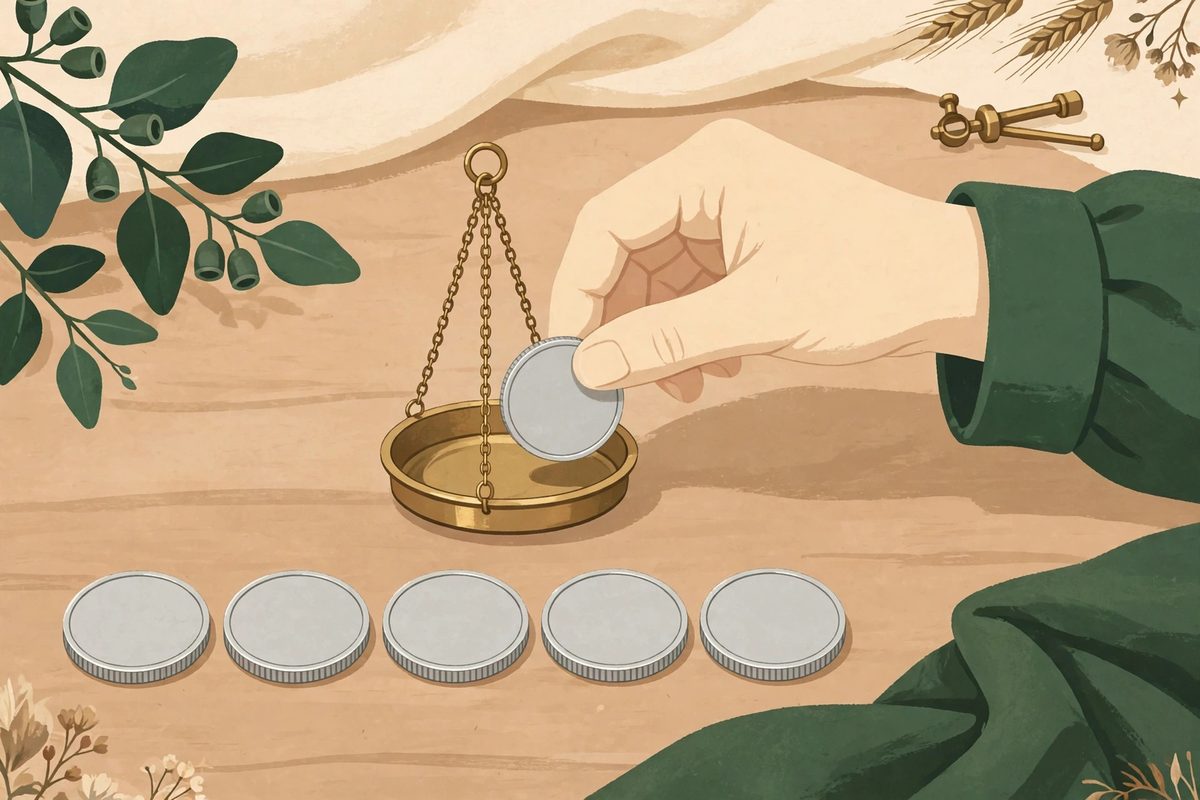
- Check the scale before you trust it. One clean, unworn nickel should read 5.00 g (allow a few hundredths either way on a pocket scale). Twenty nickels should read 100 g — the calibration point most pocket scales ask for. If your scale fails the nickel, recalibrate it or retire it before weighing anything you might sell.
- The five-second silver test. A quarter that weighs 6.25 g is silver; 5.67 g is clad. No squinting at a worn date, no edge inspection — the scale settles 1964-versus-1965 instantly. The same trick separates copper cents (3.11 g) from zinc ones (2.50 g).
- The sanity check. A Morgan dollar near 26.73 g is a healthy Morgan. Near 25 g means heavy wear or the wrong coin entirely — and a “Morgan” at 22 g is not a Morgan at all.
- Know the limit. Weight is a screen, not a verdict. Circulated coins lose a little metal honestly — a worn Morgan at 26.2 g can be perfectly genuine — and a well-made fake can hit the target weight. Weight argues with the story a coin tells; it never replaces looking at the coin itself.
Start with the humblest coin in the jar. If your scale reads the nickel right, it will read everything else right — and half the mysteries in the jar stop being mysteries.