
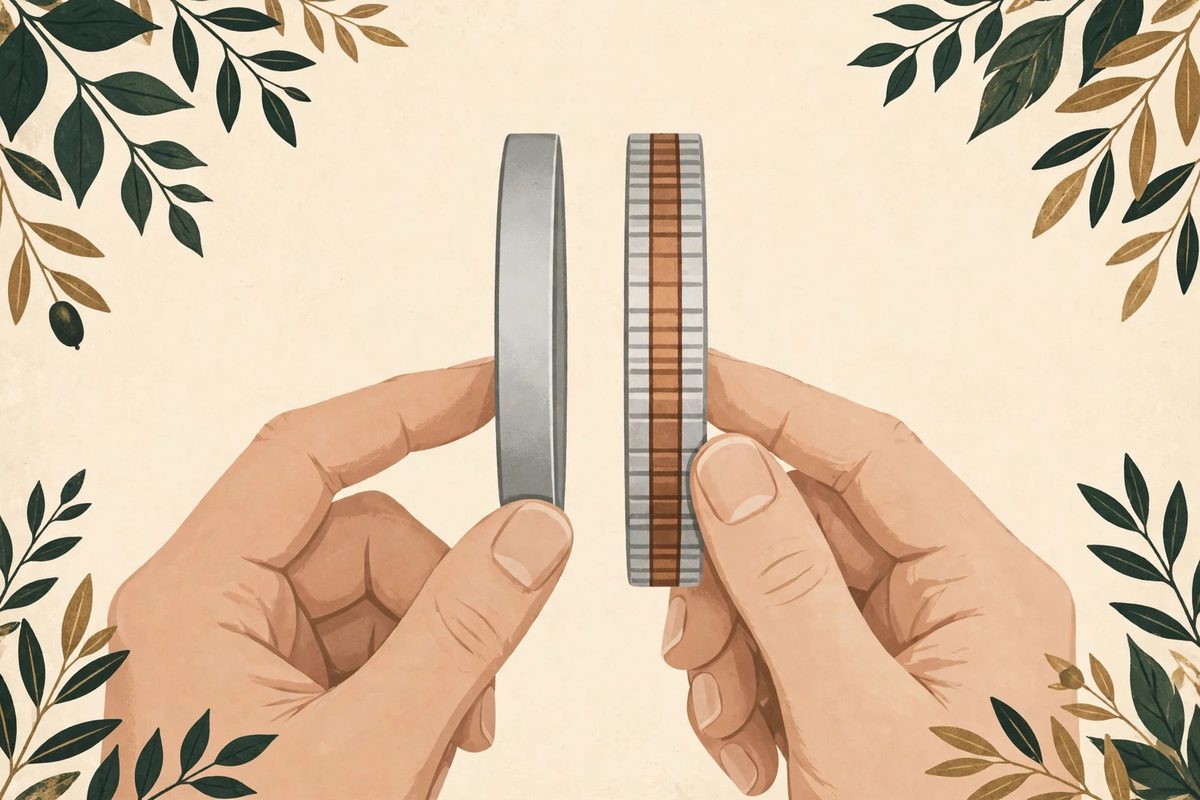
The answer, up front: read the edge
| Coin | What the edge says | Verdict |
|---|---|---|
| US dime, quarter or half dollar, solid silver-grey edge, no stripe | Struck before 1965 — 90% silver, the same metal all the way through | Keeper pile |
| US dime, quarter or half dollar, copper stripe through the middle | Clad, 1965 or later — a copper core in a sandwich | Spending pile |
| Kennedy half dollar, 1965–1970, greyish edge | 40% silver — the in-between coin; the edge can look almost like full silver | Check the date: the edge alone is a weak witness here |
| Nickel, 1942–1945, perfectly ordinary edge | 35% silver war nickel — the edge shows nothing at all | Flip it over: the tell is a large mint mark above the dome on the back |
| Canadian dime or quarter, 1968 | Part were struck in 50% silver, part in plain nickel | A magnet sticks to the nickel issue and slides off the silver one |
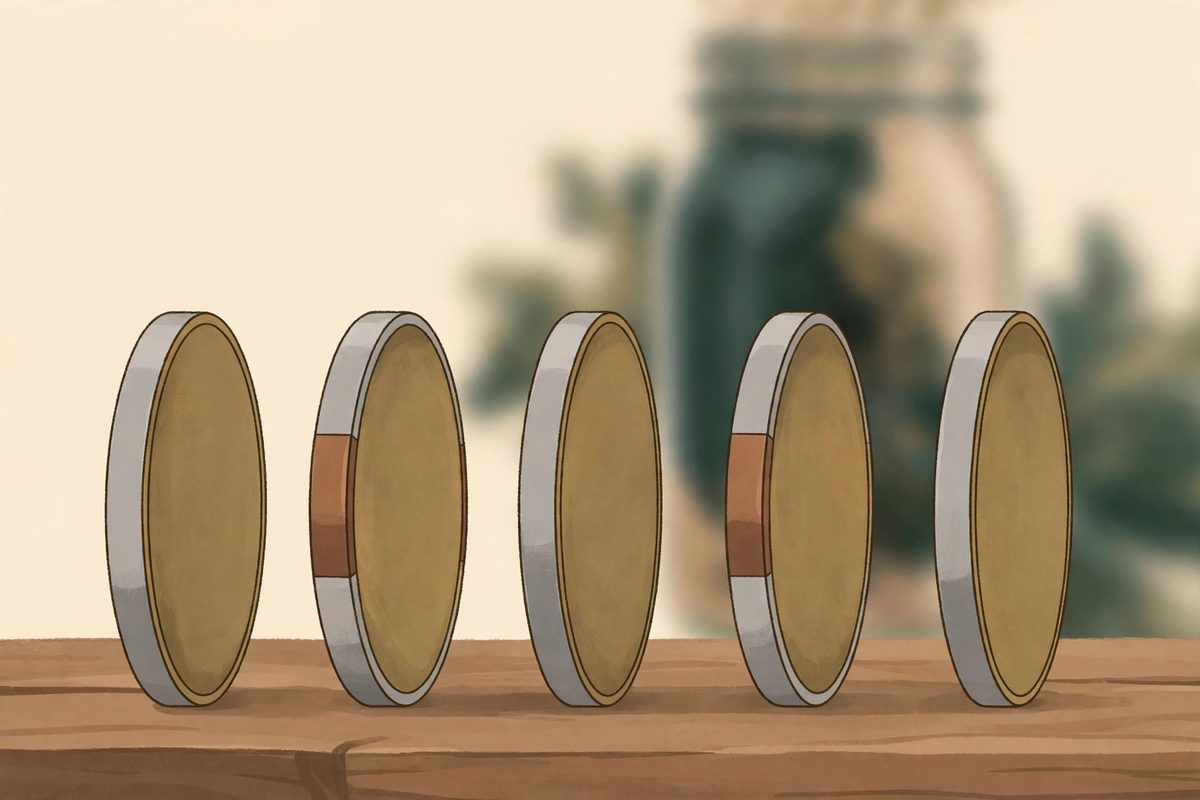
The method takes sixty seconds a handful: stand a short row of coins on edge, or hold a small stack up to the light, and read the sides instead of the faces. Grey edges go one way, striped edges the other. Dates get read afterwards, and only for the coins that earned it.
Solid grey is silver. A copper stripe is a sandwich.
The story: the year the coin became a sandwich
Up through 1964, an American dime, quarter or half dollar was silver all the way through — ninety percent silver on the faces, and ninety percent silver on the edge, because there was nothing else in it. The edge and the face were one piece of metal, and both told the same story.
In 1965 the recipe changed. The new coins kept a silvery face, but the heart of the coin became a core of copper, faced on both sides — a sandwich. The faces were made to look the same across the changeover, so a 1964 and a 1966 quarter can sit side by side and pass for twins. The edge was never meant to be looked at, and nobody disguised it: the copper core simply shows through, a stripe running around the coin like the filling in that sandwich.
The half dollar only went halfway. From 1965 to 1970 it kept forty percent silver, which is why its edge can look greyish, almost honest — a half-answer from a half-silver coin. And Canada changed its recipe in stages: 1967 dimes and quarters were struck partly in eighty percent silver and partly in fifty, and the 1968 issues split again, between fifty percent silver and plain nickel. That staged changeover is exactly why Canadian jars need one extra tool, coming up below.
What this means for your jar
- Sort by edge first. Stand each dime, quarter and half on edge, or fan a short stack against the light, and make two piles — grey edges and striped edges. A coffee can’s worth of silver-side coins takes minutes, not an evening of squinting at dates under a lamp.
- Give the halves a second look. A greyish edge on a Kennedy half dated 1965 to 1970 means forty percent silver: real silver, worth more than face value, but not the ninety percent kind. On halves, the date decides what the edge only suggests.
- Never trust the edge on a war nickel. The nickels of 1942 to 1945 are thirty-five percent silver wearing a perfectly ordinary edge. Their tell is on the back: a mint mark above the dome, larger than on any other nickel. Flip every wartime nickel over before it joins the spending pile.
- Keep a magnet beside the Canadian pile. Every 1967 Canadian dime and quarter is silver of one grade or the other — eighty percent or fifty. The 1968s are the split year: touch each one with a magnet. It sticks to the nickel issue and slides off the fifty-percent-silver one. Edge plus magnet settles 1968 in seconds.
- Confirm the keepers by date and weight. The edge is a screen, not a verdict. A silver quarter should still read 6.25 g on the scale against a clad quarter’s 5.67 g (Guide 2’s table). The edge says “probably”; the date and the scale say “yes”.
Used together, the three guides are one workflow. The edge test (this guide) makes the first cut in minutes; the scale (Guide 2) confirms the keepers in grams; and the troy-ounce math (Guide 1) explains what the scale is really saying about a one-ounce coin. Most jars only ever need the first step — the rest is for the coins that pass it.
None of this needs equipment you do not already own, or more than a minute a handful. The faces of a coin were made to be looked at. The edge was made to be believed.