
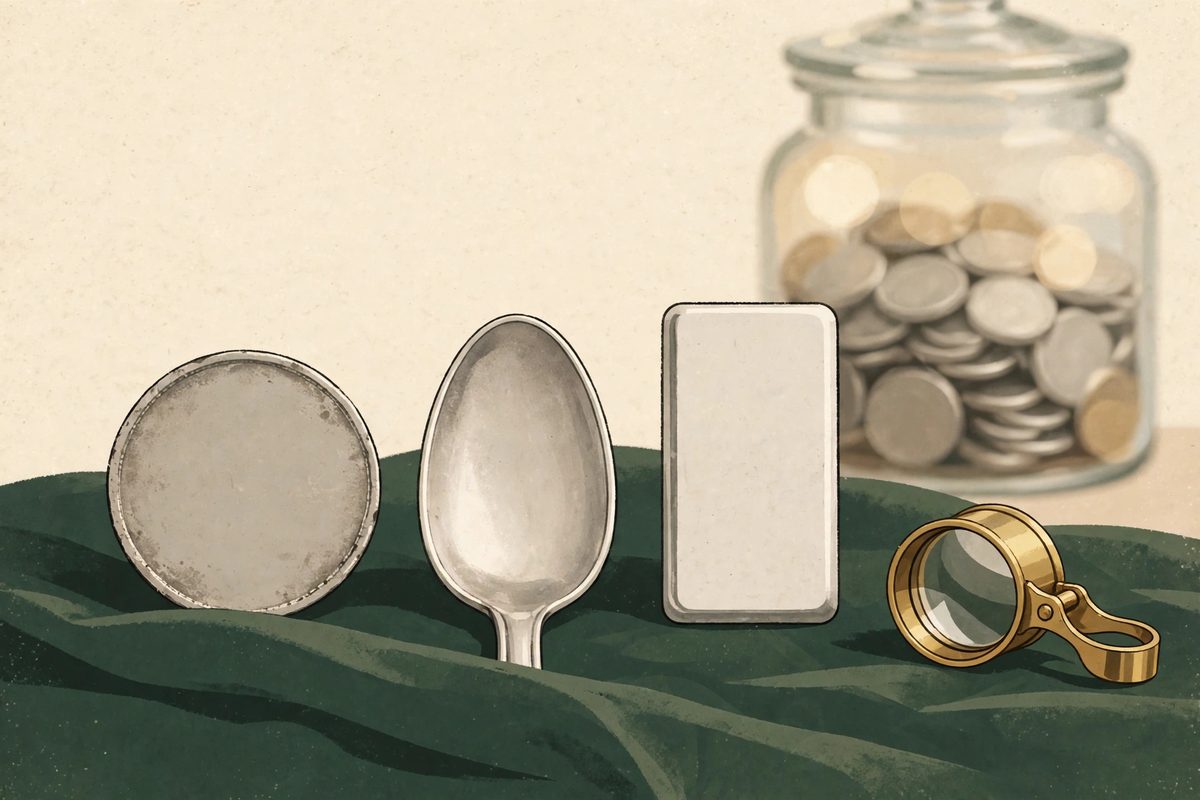
The answer, up front: the number is a share of pure silver
Fineness is parts per thousand. A piece marked .900 is 900 parts pure silver in every thousand — ninety percent — and the rest is copper, there to harden it. That single share drives everything a dealer pays for metal, because melt value is paid on the pure silver only: pure silver = the weight in troy ounces × the fineness. The marks you will actually meet:
| Mark | What it means | Where you will meet it |
|---|---|---|
| .900 | 90.0% silver | US dimes, quarters, halves and dollars struck before 1965 |
| .925 — sterling | 92.5% silver | Table silver and jewellery marked STERLING or 925; Canadian coins, 1858–1919 |
| .800 | 80.0% silver | Canadian silver coins, 1920–1967; much European table silver |
| .500 | 50.0% silver | Some Canadian dimes and quarters of 1967–68, the changeover years |
| .999 | 99.9% silver | American Silver Eagles; most modern bars and rounds |
| .9999 | 99.99% silver | Canadian Silver Maple Leafs — the four-nines standard |
One warning before the story: fineness is a share, not a score. A heavy old dollar at .900 holds more pure silver than a small modern round at .9999, because the share multiplies the weight — which is why Guide 1 (the troy ounce) and this one belong together.
Fineness is a share, not a score: .900 of something heavy beats .9999 of something light.
The story: three recipes, three histories
Coin silver, .900. A coin lives roughly — pockets, tills, vending slots — and pure silver is too soft for that life. The United States settled on ninety percent silver with ten percent copper in 1837, hard enough to circulate for a century and rich enough to be trusted at arm’s length. That recipe ran unchanged until the silver era ended in 1964, and it is the fineness behind almost every old American coin in a jar.
Sterling, .925. Table silver is polished, not pocketed, so it could afford a little more silver and a little less hardness. The 92.5 percent standard is medieval — fixed in England in the twelfth century and named for the sterling penny, the coin England’s money was built on. Canada struck its silver coins at sterling until 1919; then, with silver prices spiking after the First World War, it cut the recipe to .800 in 1920 to save money — same coins, a fifth less silver in each. The phase-out finished in 1967–68, when some dimes and quarters dropped to .500 and then to nickel, the split Guide 3 teaches you to sort with a magnet.
Fine bullion, .999 and up. Modern refining made purity cheap, and modern mints compete on it. The American Silver Eagle is struck at .999 fine; the Canadian Maple Leaf family made .9999 — four nines — its signature. Nothing circulates at these finenesses; they are made to be weighed, stamped and stacked, and the stamp matters, as the next section shows.
What this means for your jar: where the number hides, and the maths it drives
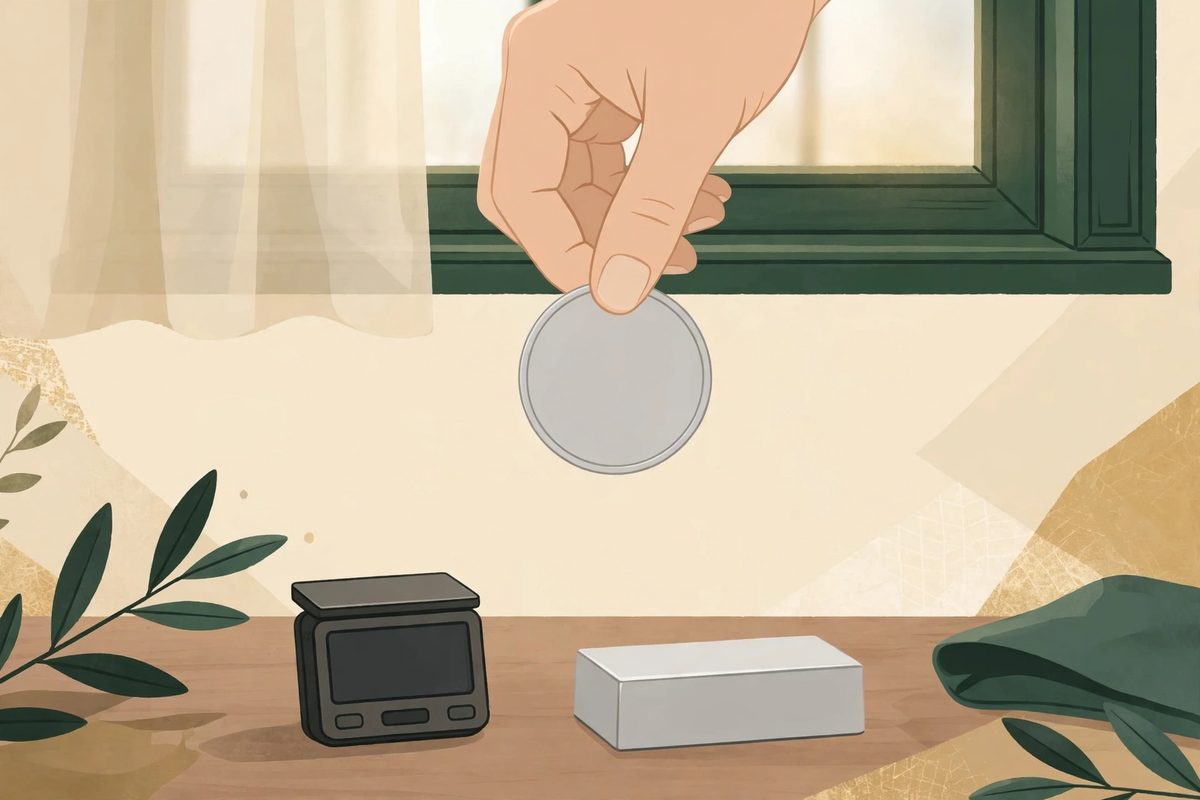
On American coins, the number is never printed. No US coin states its fineness; the date is the mark. A quarter dated 1964 or earlier is .900 by law and by recipe, and a 1965 quarter is copper-nickel clad — the edge test shows the difference in two seconds. On bars and rounds, the number is printed on the front — look for “1 oz .999 fine” struck into the metal. On table silver it is stamped small, on the back of the handle: the word STERLING or a tiny 925 means solid sterling; 800 or 835 means an eighty-something European alloy; and EPNS or “silverplate” means a whisper of silver over base metal — melt value effectively zero, however heavy the tray feels.
Then the multiplication. A Morgan dollar weighs 26.73 g — 0.859 troy ounces gross — and .900 of that is 0.773 troy ounces of pure silver, the number every Morgan melt calculation starts from. A pre-1965 quarter at 6.25 g and .900 holds 0.1808 troy ounces. A sterling fork weighing 40 g is not 40 g of silver: at .925 it holds about 1.19 troy ounces pure. And a one-ounce Silver Maple Leaf at .9999 is, for any purpose that moves a price, exactly one full troy ounce. Same scale, same jar — the fineness is what the scale cannot tell you.
Try it: three pieces, three numbers
Take three things from the house: a pre-1965 American coin, one piece of table silver, and any bar or round. Find each one’s number — by date for the coin, by the stamp for the other two. Weigh each on a 0.01 g scale (Guide 2), convert to troy ounces, and multiply by the fineness. Then check your answers in the catalogue: every series JarSort prices carries its fineness inside its melt number, from the American Silver Eagle at .999 to the Silver Maple Leaf at .9999 — and the sorter does the multiplication for you.
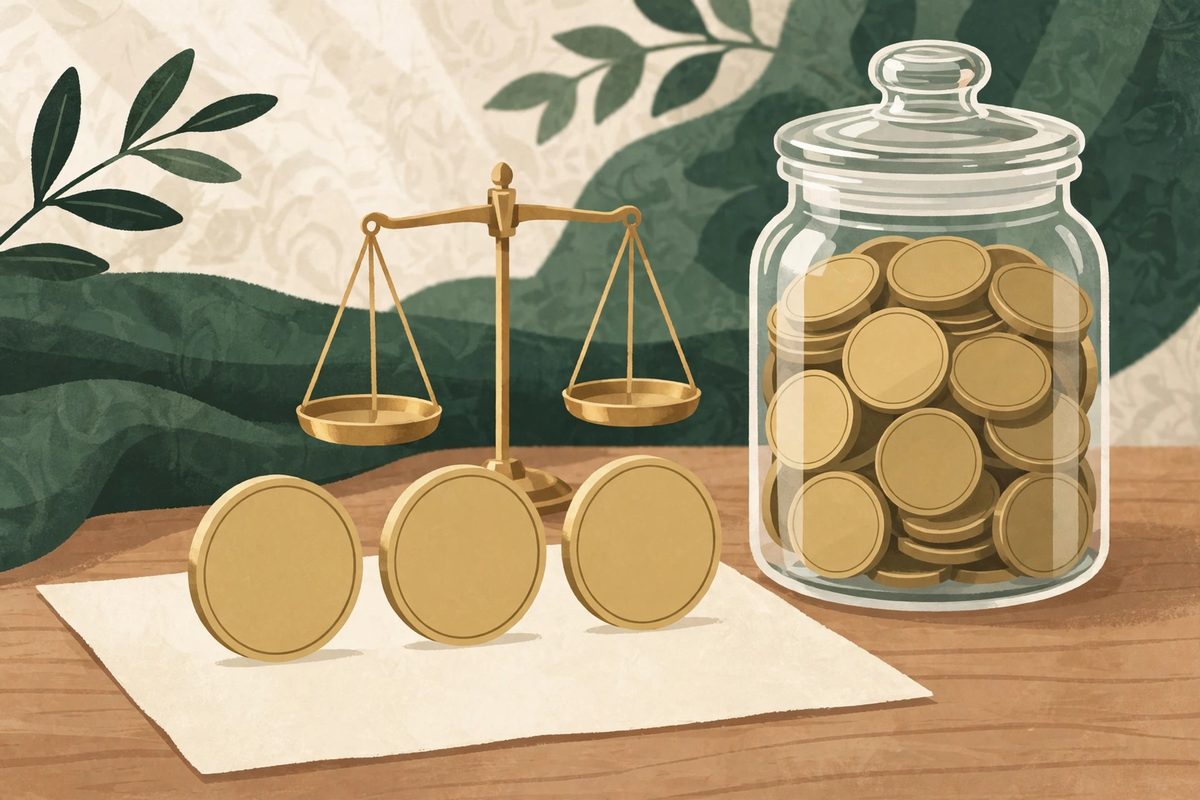
The stamp is a fraction wearing a suit: whatever follows the decimal point is the share of the metal that is really silver.